Bird guides · Winter identification
Winter Birds of the Northeast
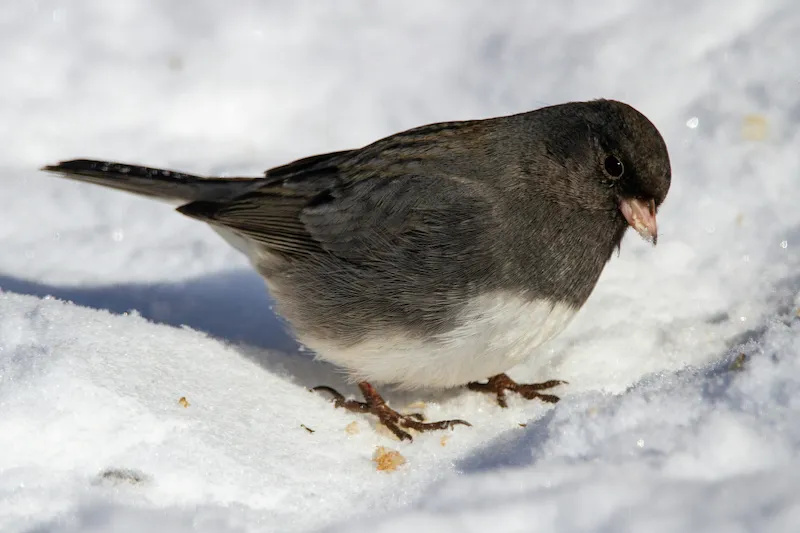
The short answer: most of the birds at a Northeast feeder in winter are year-round neighbors — chickadees, cardinals, Blue Jays, woodpeckers, nuthatches, goldfinches, and House Finches. The most widespread of all, though, is a winter visitor: in Project FeederWatch's Northeast data for winter 2025–26, Dark-eyed Juncos showed up at 92% of feeders. A few more birds come down from the north each fall. In some winters, northern finches like Pine Siskins and Evening Grosbeaks join them. This year's forecast says many of those finches will stay in the woods rather than at feeders.
Winter is the best season to learn your feeder birds. The cast is smaller, the birds come back every day, and there are no leaves to hide them. Here's who to expect, how to tell the look-alikes apart, and what the 2026–27 finch forecast says.
By the My Window Birds editors · Published November 23, 2026 · Sources
The 10 most widespread winter feeder birds in the Northeast
These numbers come from Project FeederWatch, where more than 10,000 households in its Northeast region counted the birds at their feeders from November 2025 through April 2026. The percentage is the share of those feeders each species visited at least once.
| Bird | Share of feeders | When it's here |
|---|---|---|
| Dark-eyed Junco | 92% | Winter visitor in most of the region |
| Chickadees (Black-capped and Carolina) | 90% | Year-round |
| Northern Cardinal | 89% | Year-round |
| Blue Jay | 86% | Year-round; some move south in fall |
| Downy Woodpecker | 86% | Year-round |
| Mourning Dove | 86% | Year-round |
| American Goldfinch | 80% | Year-round, in drab winter colors |
| White-breasted Nuthatch | 77% | Year-round |
| House Finch | 76% | Year-round |
| Red-bellied Woodpecker | 73% | Year-round |
Just below the top 10 are the Tufted Titmouse (63%) and, surprisingly to many people, the American Robin (63%). Many robins spend the winter here; see where robins go in winter. Further down the list come the White-throated Sparrow (55%), Red-breasted Nuthatch (40%), and Purple Finch (34%). All ten top birds, plus the titmouse, robin, and White-throated Sparrow, have their own cards in our guide to the 15 birds of the Northeast.
One caution: FeederWatch's "Northeast" region covers more than the nine states this site focuses on, so treat the numbers as a regional picture, not a count for your own state.
The birds that come down from the north
Three birds arrive in fall from farther north and are mostly gone by spring. All three feed on the ground, so scatter white proso millet or sunflower chips under the feeders or on a low platform.
- Dark-eyed Junco. The "snowbird." In the East it's slate gray on the head, back, and sides, with a crisp white belly and a pale pink bill. Look for bright white outer tail feathers flashing as it flies up. More in our junco guide.
- White-throated Sparrow. A brown sparrow with a clean white throat and a yellow spot in front of the eye. The head stripes come in two forms, white or tan. Audubon notes it comes to feeders placed close enough to the shelter of thickets, so a feeder near shrubs helps.
- American Tree Sparrow. Breeds in the high tundra of the Canadian north, Mass Audubon notes, and comes south to weedy fields and backyard feeders. It has a rusty cap, a two-toned bill (dark above, yellow below), a dark spot in the middle of a plain breast, and two white wing bars.
The "winter finches": some years yes, some years no
A handful of northern birds don't migrate on a fixed schedule. When seed and fruit crops fail in the northern forests, they "irrupt" south, sometimes in large numbers. When crops are good, they stay north. These are the ones to watch for:
- Pine Siskin. A small brown finch that might suggest a sparrow, but with a narrow, sharp-pointed bill and yellow edging on the wings and tail, most obvious in flight. Offer nyjer and sunflower.
- Redpoll. Small, with a red forehead, a black chin, and a yellow bill; males have a pink wash on the chest. Audubon notes they are often remarkably tame at feeders. Offer nyjer and sunflower. (In 2024 the American Ornithological Society merged Common and Hoary Redpolls into a single species, now called simply "Redpoll.")
- Evening Grosbeak. A big, noisy finch, gray and gold with a large white patch on black wings and a heavy pale bill. Males have a yellow eyebrow. Black-oil sunflower on a platform feeder is the way to its heart.
- Purple Finch. Easy to confuse with the House Finch (see below). It prefers black-oil sunflower.
- Pine Grosbeak. A big northern finch that Audubon describes as often "absurdly tame." In winter look for it in fruiting trees such as mountain-ash and crabapple; at feeders it takes sunflower.
- Red-breasted Nuthatch. A small nuthatch with a black eye stripe, a white eyebrow, and buffy-orange underparts. Its call is a tinny, nasal yank-yank. It favors black-oil sunflower, peanuts, and especially suet.
- Bohemian Waxwing. A northern cousin of the Cedar Waxwing that travels in flocks and lives on berries and fruit in winter, so look for it in fruiting trees, not at seed feeders.
Crossbills, whose bill tips really do cross, also move south in some winters. They feed mostly on the seeds of spruce, pine, and other conifers, so look for them in evergreen woods.
The 2026–27 winter finch forecast
Every fall the Finch Research Network publishes a forecast based on seed and fruit crops across Canada's boreal forest. This year's forecast, by Tyler Hoar, was published on September 25, 2026. Its big picture for our region: seed crops are good in the East, so finches moving out of the poorer central boreal will likely spread into eastern Canada, the Great Lakes, and the northeastern U.S. But they "will likely be in the woods more than at feeders," and no big irruptions are expected farther south.
| Bird | 2026–27 outlook for the Northeast | At the feeder |
|---|---|---|
| Pine Siskin | Very good cedar, hemlock, and white pine seed in the Northeast; expect them mostly in the forests | Nyjer, sunflower |
| Evening Grosbeak | Small to medium flocks in the northeastern U.S.; a small move into southern New York, Pennsylvania, and Massachusetts "quite possible" | Black-oil sunflower |
| Purple Finch | Many will winter in the Northeast; any flight farther south would be late and small | Black-oil sunflower |
| Redpoll | Most should stay in Canada; maybe a small irruption in northeastern border areas | Nyjer, sunflower |
| Pine Grosbeak | Not much of a flight expected | Sunflower, fruit |
| Red-breasted Nuthatch | No large flight like last winter's | Suet, peanuts, sunflower |
| Bohemian Waxwing | Some near the Canadian border, few farther south | Fruit |
| Blue Jay | An above-average flight along Lakes Ontario and Erie | Peanuts, sunflower |
What this means at home: keep nyjer and black-oil sunflower stocked and watch for siskins and grosbeaks, but don't be surprised by a quiet finch winter. Your chances are best close to the northern forests. Farther south, few or no northern finches is the likely outcome, and that is no fault of your feeder.
Telling the look-alikes apart
House Finch or Purple Finch? This is the classic winter puzzle. FeederWatch's identification tips:
- A male Purple Finch looks as if a brown, streaky bird had been "dipped in raspberry jam": the rosy color covers the whole head and chest. A male House Finch has a red "headband" that contrasts with a brown cap and a brown cheek patch, and streaky brown sides.
- A female Purple Finch has a bold, striped face: a bright white eyebrow, a dark cheek patch, and a white stripe below it. A female House Finch lacks a strong facial pattern.
- Shape: the Purple Finch is chunkier, with a short, deeply notched tail.
American Tree Sparrow or Chipping Sparrow? In winter, the tree sparrow has a rusty-brown eye line and a two-toned bill, dark above and yellow below. A Chipping Sparrow has a black or dark brown eye line and a pinkish bill. FeederWatch warns that the famous field mark, the tree sparrow's breast spot, "can be deceptively unreliable." Check the bill and eye line instead.
Downy or Hairy Woodpecker? See the bill-length test in our woodpecker guide.
How to bring more winter birds in
- Black-oil sunflower feeds most of the birds on this page. If you buy only one seed, buy that (our bird food guide explains why).
- White proso millet on the ground or a low platform is for juncos and the sparrows.
- Nyjer in a thistle feeder is for goldfinches, siskins, and redpolls. Keep it fresh.
- Suet brings woodpeckers, nuthatches, and chickadees.
- Open water brings birds that never touch seed. See how to keep a bird bath from freezing.
For the full cold-weather menu, see what to feed birds in winter. And if you'd like to put your winter list to use, the Christmas Bird Count runs December 14 to January 5, and you can take part from your own feeder.
The bottom line
Most Northeast winter feeder birds are year-round residents, joined by juncos, White-throated Sparrows, and American Tree Sparrows from the north. The northern finches are a bonus that comes in some winters and not others. For 2026–27, the forecast says good seed crops will keep most of them in the northern woods rather than at feeders. Keep sunflower, millet, nyjer, and suet out, learn the few look-alike pairs, and winter becomes the easiest season of the year to know your birds.
Get the free guide: Backyard Birds of the Northeast
Keep the ID cards by the window. The free printable PDF covers the 15 most common Northeast feeder birds — how to recognize each one and what it eats.
Download the Free GuideCommon questions
What birds stay in the Northeast all winter?
Most familiar feeder birds do: chickadees, Northern Cardinals, Blue Jays, Downy and Red-bellied Woodpeckers, White-breasted Nuthatches, Tufted Titmice, Mourning Doves, American Goldfinches, and House Finches. Many American Robins stay too, though they eat fruit rather than seed.
Which birds come to the Northeast only in winter?
The Dark-eyed Junco, White-throated Sparrow, and American Tree Sparrow arrive from the north in fall and leave in spring. In some winters northern finches also come south: Pine Siskins, redpolls, Evening and Pine Grosbeaks, and Red-breasted Nuthatches.
What is the winter finch forecast for 2026–2027?
The Finch Research Network's 2026–27 forecast expects good seed crops in the East to keep many northern finches in the woods rather than at feeders. Pine Siskins and Purple Finches should be in northeastern forests, with a possible small push of Evening Grosbeaks into southern New York, Pennsylvania, and Massachusetts.
How do I tell a Purple Finch from a House Finch?
On a male Purple Finch the raspberry color covers the whole head and chest. A male House Finch has a red band over a brown cap and brown cheek, with streaky sides. Female Purple Finches have a bold white eyebrow; female House Finches lack a strong face pattern.
Why haven't I seen redpolls or siskins at my feeder this winter?
They come south only when northern seed crops fail. For 2026–27, crops in the East are good, so the forecast expects most redpolls to stay in Canada and siskins to feed in the forests. A quiet finch winter is normal and not a sign that anything is wrong with your feeder.
Sources
- Project FeederWatch — Top 25 Feeder Birds (Northeast region, 2025–26 season)
- Finch Research Network — Winter Finch Forecast 2026–2027
- Project FeederWatch — Tricky Bird IDs: Cassin's Finch, House Finch, and Purple Finch
- Project FeederWatch — Tricky Bird IDs: American Tree Sparrow and Chipping Sparrow
- American Ornithological Society — 65th Supplement to the Check-list of North American Birds (2024)
- Mass Audubon — American Tree Sparrows
- National Audubon Society — Guide to North American Birds: Redpoll
- National Audubon Society — Guide to North American Birds: Evening Grosbeak
- National Audubon Society — Guide to North American Birds: Pine Siskin
- National Audubon Society — Guide to North American Birds: Red-breasted Nuthatch
- National Audubon Society — Guide to North American Birds: White-throated Sparrow
- National Audubon Society — Guide to North American Birds: American Tree Sparrow
- National Audubon Society — Guide to North American Birds: Pine Grosbeak
Keep reading: meet the 15 birds of the Northeast, see what to feed birds in winter, or get to know the Dark-eyed Junco, the most widespread winter feeder bird in the region.