Bird guides · Tufted Titmouse
How to Attract Tufted Titmice
The short answer: black-oil sunflower, plain shelled peanuts, and suet, in a tube, hopper, or suet feeder within a short flight of trees. Titmice take one seed at a time and fly off to open it, so cover nearby matters as much as the feeder. For nesting, put up a box with a 1¼-inch entrance hole near large deciduous trees.
Tufted Titmice are one of the most common feeder birds in the Northeast: last winter they visited 63% of the feeders in Project FeederWatch's Northeast region. That's a recent change. In Massachusetts the titmouse was a rarity until 1959. Here's how to bring them in, and what to watch for once they arrive.
By the My Window Birds editors · Published November 25, 2026 · Sources
How to recognize a Tufted Titmouse
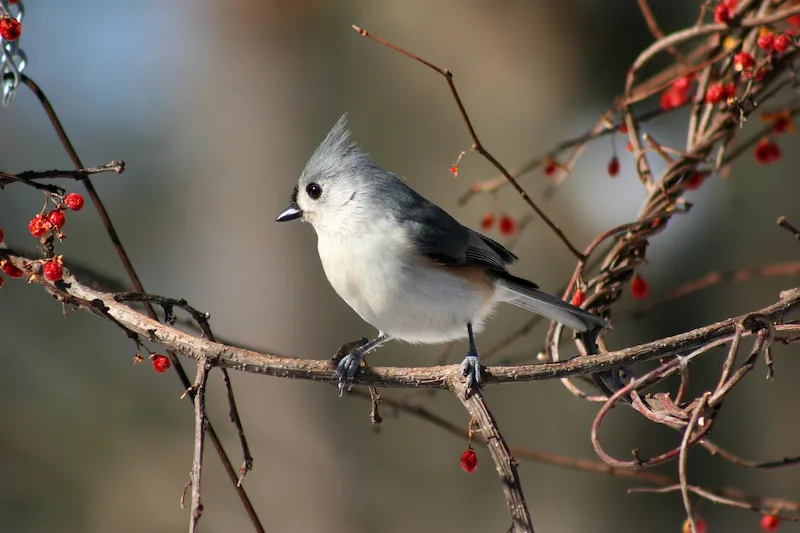
Audubon's field guide describes a bird about 6 inches long, "mostly gray and white with perky crest, pale face, black forehead, rusty sides." Look for:
- A pointed gray crest.
- A small black patch just above the bill.
- Large, dark eyes in a plain pale face.
- A peach or rusty wash along the sides, below the wings.
Male vs. female: you can't tell them apart by looks. Connecticut DEEP and Tennessee's wildlife agency both note that the sexes look alike. Young birds have a shorter crest and no black on the forehead, according to the Tennessee Wildlife Resources Agency.
The song: a clear, whistled peter-peter-peter, four to eight notes repeated over and over (Audubon). Both sexes sing, and Mass Audubon notes the song can be heard in any month. It gets loudest in late winter and early spring, when pairs are claiming territories; Tennessee's agency says territorial singing can start as early as mid-January. In winter you'll also hear nasal, scratchy calls as titmice move through the trees with chickadees.
What titmice eat
In the wild, insects make up close to two-thirds of a titmouse's diet over the year, with caterpillars the most important prey in summer. Seeds, nuts, and berries matter most in winter, according to Audubon's field guide. That's when they come to feeders.
| Food | Why it works | Good to know |
|---|---|---|
| Black-oil sunflower | Mass Audubon calls it the favorite of most feeder birds | Tube, hopper, or platform |
| Peanuts | "Relished by tufted titmice," says Connecticut DEEP | Shelled, dry-roasted, unsalted (Audubon) |
| Suet | Fat and protein for cold days | A cage feeder; skip it in hot weather, when it can turn rancid |
| Safflower | On Connecticut DEEP's list of best titmouse foods | Good in a tube or hopper |
| Peanut butter | A soft, high-energy treat | Audubon's summer mix: 1 part to 5 parts cornmeal |
FeederWatch adds that small birds like chickadees, nuthatches, and titmice do better with shelled peanuts than whole ones, and that titmice also relish mealworms. For a side-by-side look at seeds, see our bird food guide.
The one-seed habit
Watch a titmouse at the feeder and you'll see the pattern: land, grab one seed, and leave. Audubon notes it often carries away sunflower seeds one at a time, then opens them by holding them with its feet and pounding with its bill. With a peanut, Connecticut DEEP says, a titmouse flies off to a secluded perch to work on the shell.
Titmice also store food to eat later. Audubon notes they "will store food items, retrieving them later," tucking seeds away for leaner days.
Two things follow from this:
- Put the feeder near cover. A bird that makes dozens of round trips wants a branch close by. Trees or shrubs within a short flight of the feeder help (see where to hang a bird feeder for distances).
- Don't worry about the "missing" seed. A feeder that empties fast with only a few titmice around isn't being wasted. Some of that seed is being stored away for later.
The best feeders for titmice
Connecticut DEEP says titmice will use almost any type of feeder. Three work especially well:
- Tube feeders with black-oil sunflower, safflower, or peanuts. Audubon lists titmice among the regulars. A tube inside a small wire-mesh cage keeps out bigger, bossier Blue Jays and grackles while titmice slip through (Connecticut DEEP).
- Hopper feeders, which draw the same small birds plus cardinals and jays.
- Suet cages, popular with titmice, chickadees, nuthatches, and woodpeckers.
Titmice find new feeders quickly; Audubon's feeding guide names chickadees and titmice among the fastest. Whatever you use, keep it clean: wash feeders about every two weeks (here's how to clean a bird feeder).
Titmice in winter: the chickadee crowd
Titmice don't migrate. In winter, Mass Audubon notes, "you often see and hear them with chickadees, nuthatches, and small woodpeckers." If chickadees already visit your yard, titmice are often a few branches behind. Our guide to attracting chickadees uses the same foods and feeders.
Titmouse pairs often stay together all year, and Audubon notes that flocks break up in late winter as pairs settle on territories. Sometimes a pair keeps a helper: one of their offspring from the previous year, which stays to help raise the next brood.
A bird that moved north
Titmice haven't always been here. Vermont's second breeding bird atlas notes that before the early 1900s, the northern edge of their breeding range was northern New Jersey and southern New York. Then they spread:
- Massachusetts: first bred in the late 1950s. By the early 1970s, Mass Audubon says, titmice had "saturated the state," and they now turn up in 92% of the state's atlas blocks.
- New Hampshire: first nesting in 1973.
- Vermont: first nesting in 1976. The species went from 9 atlas blocks in the state's first atlas to 104 in the second, and it's now common everywhere except the far northeast.
In all, the Vermont atlas says, titmice pushed their breeding range more than 300 miles north. The likely reasons: a warming climate, maturing forests, and the spread of winter bird feeding. One thing they still avoid is open water. Mass Audubon notes they have never settled on Nantucket.
Nest boxes, and the hair thieves
Titmice nest in tree holes: natural cavities or old woodpecker holes. Audubon notes they apparently don't dig their own, so a nest box is a real help. Box guidelines from NestWatch, Connecticut DEEP, and Mass Audubon:
- Entrance hole: 1¼ inches across (all three agree).
- Floor: 4 × 4 inches (Mass Audubon, Connecticut DEEP) up to 5½ × 5½ inches (NestWatch).
- Depth: about 8 to 10 inches.
- Mounting: 5 to 15 feet up, on a pole, near large deciduous trees, with the hole facing away from the prevailing wind (NestWatch).
- Inside: Mass Audubon suggests about 3 inches of wood chips.
In Massachusetts, nest building begins in late April and eggs are found from mid-May into July. Titmice raise one brood a year.
The hair thieves: titmice line their nests with soft fur, and they don't always wait for it to be shed. Audubon notes a titmouse "may pluck hair from live woodchuck, dog, or other animal, even from humans." In 2021, University of Illinois researchers rounded up dozens of online videos showing titmice (and, once, a chickadee) plucking hair from 47 people, 45 dogs, three cats, three raccoons, and a porcupine. (One raccoon didn't even wake up.) Why they do it isn't known. The researchers suggest the hair may insulate the nest, its mammal smell may deter predators like snakes, or it may help repel parasites.
Plants that feed titmice
Feeders help in winter, but trees feed titmice all year. Audubon recommends birches and sumacs for chickadees and titmice: birches host hundreds of kinds of caterpillars, and sumacs hold red berries into winter. Connecticut DEEP adds oaks and beeches for acorns and beechnuts, plus berries like serviceberry, blueberry, and bayberry. A yard with a few big deciduous trees is titmouse country.
The bottom line
To attract Tufted Titmice, offer black-oil sunflower, shelled unsalted peanuts, and suet in a tube, hopper, or suet feeder close to trees or shrubs. Keep it clean and keep it full through the winter. Put up a nest box with a 1¼-inch hole by late April. Then listen for peter-peter-peter: a bird that was rare in New England 70 years ago may soon be raising a family in your yard.
Get the free guide: Backyard Birds of the Northeast
The Tufted Titmouse is one of 15 birds in our free printable guide. Get a card for each one: how to recognize it and exactly what to feed it.
Download the Free GuideCommon questions
What is the best food to attract Tufted Titmice?
Black-oil sunflower seed is the everyday favorite, and plain shelled peanuts are a close second. Suet, safflower, and peanut butter also work. Use dry-roasted, unsalted peanuts, never salted or flavored.
What kind of feeder do titmice like?
Almost any. Tube feeders with sunflower or peanuts, hopper feeders, and suet cages all work well. A tube inside a small wire cage keeps out larger birds like jays and grackles while titmice get through.
Can you tell male and female titmice apart?
Not by looks. Males and females have the same gray crest, black forehead, and rusty sides. Young birds have a shorter crest and no black above the bill. Behavior is the clue: only the female sits on the eggs, and the male often brings her food.
What does a Tufted Titmouse sound like?
Its song is a loud, whistled "peter-peter-peter," four to eight notes repeated over and over. Both males and females sing, in any month, but most of all in late winter and spring. Its calls are harsh and nasal, like a scolding "day-day-day."
Do Tufted Titmice use birdhouses?
Yes. Titmice nest in tree holes and don't dig their own, so they readily use nest boxes. Use a 1¼-inch entrance hole and a floor of about 4 to 5½ inches square, and mount it 5 to 15 feet up near large deciduous trees.
Sources
- National Audubon Society — Guide to North American Birds: Tufted Titmouse
- Connecticut DEEP — Connecticut Wildlife, November/December 2006: chickadees and titmice (PDF)
- Tennessee Wildlife Resources Agency — Tufted Titmouse
- Mass Audubon — Breeding Bird Atlas 1: Tufted Titmouse
- Mass Audubon — Breeding Bird Atlas 2: Tufted Titmouse
- Mass Audubon — Nature almanac, December 2025 (PDF)
- Vermont Center for Ecostudies — Second Atlas of the Breeding Birds of Vermont: Tufted Titmouse (PDF)
- National Audubon Society — Top 10 Foods for Winter Bird Feeding
- National Audubon Society — Audubon Guide to Winter Bird Feeding
- National Audubon Society — Audubon Guide to Bird Feeding (PDF)
- Project FeederWatch — Feeding Birds
- Project FeederWatch — Top 25 Feeder Birds (Northeast region, 2025–26 season)
- NestWatch — Tufted Titmouse nest box
- Connecticut DEEP — Nest Boxes and Structures for Wildlife
- Mass Audubon — Birdhouse dimensions (PDF)
- University of Illinois News Bureau — Some birds steal hair from living mammals (2021)
- National Audubon Society — Grow These Native Plants So Your Backyard Birds Can Feast
Keep reading: titmice travel with chickadees, so see how to attract chickadees, meet the 15 birds of the Northeast, or see who else turns up in winter birds of the Northeast.