Bird guides · Winter visitors
Dark-eyed Juncos: The Snowbirds Are Back
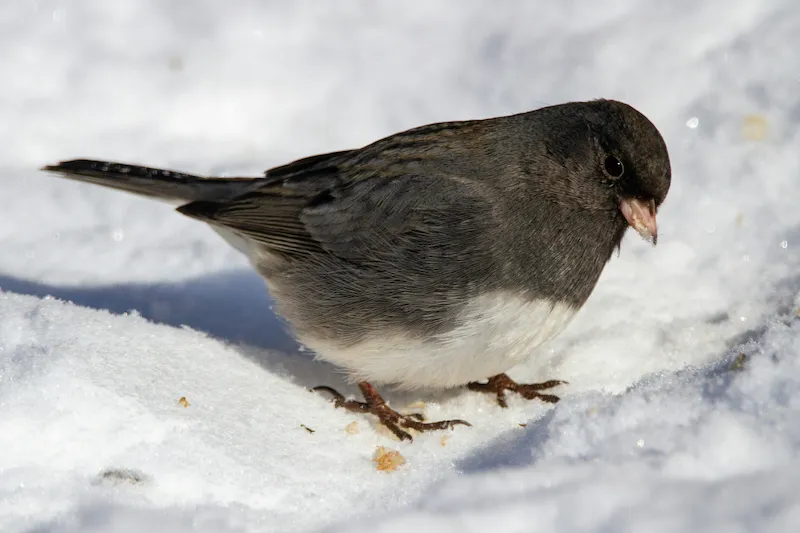
If small slate-gray birds with clean white bellies have just started hopping around under your feeder, the snowbirds are back. Dark-eyed Juncos arrive across the Northeast in fall — the movement peaks in mid-October — and stay until April. To feed them, scatter white proso millet or sunflower chips on the ground or a low platform near shrubs. They rarely use hanging feeders.
Juncos are among the most reliable winter visitors there are. In Project FeederWatch counts, they typically turn up at about 95% of New England feeders each winter, and nationally they're often the single most widespread feeder bird. Here's how to recognize them, when to expect them, and how to make your yard part of their winter routine.
By the My Window Birds editors · Published October 8, 2026 · Sources
How to recognize a junco
The junco is a sparrow — about 6 inches long — but it doesn't look like the brown, streaky sparrows most people picture. In the East you'll see the form called the Slate-colored Junco:
- Slate gray above, white below. Males are a uniform dark gray on the head, back, and wings, with a crisp white belly — "leaden skies above, snow below," as the old description goes.
- Females are browner. Females and young birds show varying amounts of brown mixed into the gray.
- A pale pink bill. Small, conical, and pinkish — it stands out against the gray face.
- White flashes in the tail. When a junco flies up, bright white outer tail feathers flash on both sides. It's the quickest way to know what you just flushed.
- No streaks at all. Unlike other Northeast sparrows, juncos have no stripes or streaks on the face, breast, or belly.
Listen, too. Feeding flocks keep in touch with sharp "tsick" and "tchet" notes. In late winter you may hear the song: a ringing, metallic trill on a single pitch.
Why are they called snowbirds?
Because they arrive with the cold and leave with the spring. For much of the Northeast, the first juncos under the feeder are a sure sign that winter is on the way — Mass Audubon calls the junco the "harbinger of winter." They also seem at home in it: juncos scratch through fresh snow for seeds and forage happily on snowy days when other birds lie low.
When do juncos arrive in the Northeast?
- Late September: the first migrants start moving south from Canada and northern New England.
- Mid-October: the peak. In Massachusetts, fall movement peaks in mid-October and winds down around Thanksgiving.
- October through April: wintering flocks settle into yards and woodland edges across the region.
- April: they head north to breed.
Not every junco leaves for the summer. Some nest in conifer and mixed forests in the mountains of northern New England and New York — and in western Massachusetts east to Worcester County — so in those areas you may see a few year-round. For most of the region, though, juncos are a strictly cold-season treat.
One curious detail: male juncos tend to winter a little farther north than females. Flocks in northern yards often lean male, while more females continue south.
What do juncos eat?
In winter, wild juncos live mostly on the seeds of weeds and grasses, plus a few berries. (In summer, close to half their diet is insects.) At your feeder, they look for small seeds on the ground:
| Food | How juncos take it |
|---|---|
| White proso millet | The favorite. Scatter it on the ground or a low platform |
| Sunflower chips or hearts | Easy for a small bill; no shells to crack |
| Black-oil sunflower | Eaten readily, especially seed other birds drop |
| Cracked corn | Taken happily — offer small amounts, since it spoils when wet |
| Nyjer | Spilled seed under a finch feeder gets cleaned up |
Skip mixes heavy with red milo; juncos and most other birds leave it on the ground. Our bird food guide has the full seed-by-seed chart.
How to set up a junco-friendly feeding spot
Juncos are ground feeders by nature. They'll visit a hanging feeder now and then, but most of them work the ground beneath it, so set up for them where they're comfortable:
- Feed low. A low platform feeder a few inches off the ground is ideal; it keeps seed off wet soil. Or simply scatter a handful of millet on open ground.
- Keep cover close. Place the feeding spot within about 10 to 15 feet of shrubs, a hedge, or a brush pile, so the flock can dart to safety when a hawk passes. (More on spacing in where to hang a bird feeder.)
- Clear the snow. After a snowfall, sweep a patch of ground or brush off the platform before you scatter seed. A board or an upside-down tray on the snow works as an instant feeding table.
- Offer only what gets eaten. Scatter enough for a day, not a week. Old seed on the ground turns moldy and draws rodents.
- Think about cats. Ground-feeding birds are the most vulnerable to cats, so keep the spot away from low, dense shrubs where a cat could hide — and keep your own cats indoors.
A brush pile or your old Christmas tree propped near the feeding area gives juncos a windbreak and a hiding place. For the rest of the cold-season menu, see what to feed birds in winter.
Life in a junco flock
Watch a junco flock for a few minutes and you'll see it isn't a free-for-all. Winter flocks have a pecking order: adult males usually rank highest and eat first, with young birds and females further down the line. A dominant bird often chases another off a choice patch of seed with a quick lunge and a flash of white tail feathers. It looks quarrelsome, but it settles who eats where and keeps real fights to a minimum.
Flocks often stay loyal to the same area through the winter, which is why the juncos under your feeder in December are probably the same birds that arrived in October.
Is it really a junco?
A few birds get mistaken for juncos at first glance:
- Eastern Towhee: larger, with rusty-orange sides and, in the male, a black hood. It also scratches on the ground, but it's much bigger and boldly colored.
- Black-capped Chickadee: gray and white, but with a black cap and bib, and it feeds in trees and at hanging feeders.
- Tufted Titmouse: soft gray with a crest and peach-washed sides; a feeder bird, not a ground feeder.
If it's slate gray, hopping on the ground, pink-billed, and flashing white in the tail, it's a junco.
The bottom line
Dark-eyed Juncos arrive across the Northeast from late September through October and stay until April. Scatter white proso millet or sunflower chips on the ground or a low platform near cover, keep the snow cleared, and offer only what gets eaten each day. In return, you'll get a busy little flock of snowbirds outside your window all winter.
Get the free guide: Backyard Birds of the Northeast
The junco is one of 15 birds in our free printable guide. Get a card for each one — how to recognize it and exactly what to feed it.
Download the Free GuideCommon questions
When do juncos come back to the Northeast?
The first Dark-eyed Juncos move south in late September, and the migration peaks in mid-October. Most stay through the winter and leave for their breeding grounds in April. In the mountains of northern New England and New York, some juncos stay year-round.
What is the best food for juncos?
White proso millet, scattered on the ground or on a low platform feeder. Juncos also eat sunflower chips, black-oil sunflower seed, and small amounts of cracked corn.
Why are juncos called snowbirds?
Because they show up as the weather turns cold and leave when spring arrives — in much of the Northeast, the first juncos at the feeder are a sign winter is coming. They also forage readily in snow.
Why do juncos only eat on the ground?
It's how they're built to feed. Juncos naturally hop and scratch for fallen seeds on the ground, so they're more comfortable eating below a feeder than clinging to one. A low platform or scattered seed suits them best.
How can you tell a male junco from a female?
Males are a clean, uniform slate gray above. Females and young birds have varying amounts of brown mixed into the gray. Both have white bellies, pale pink bills, and white outer tail feathers.
Sources
- National Audubon Society — Guide to North American Birds: Dark-eyed Junco
- Mass Audubon — Dark-eyed Juncos
- Project FeederWatch — Top 25 Feeder Birds, New England region
- Cornell Lab of Ornithology — All About Birds: Dark-eyed Junco
Keep reading: meet the 15 birds of the Northeast, see what to feed birds in winter, learn how to attract woodpeckers, or keep the seed for the birds with squirrel-proof feeding.