Bird guides · Woodpeckers
How to Attract Woodpeckers
Put out suet. A plain suet cake in a wire cage is the most reliable way to bring woodpeckers to a backyard feeder. Add peanuts and black-oil sunflower, give the bigger species something to brace their tails against, and leave a dead tree standing if you safely can — and a Northeast yard can host five or more kinds of woodpeckers.
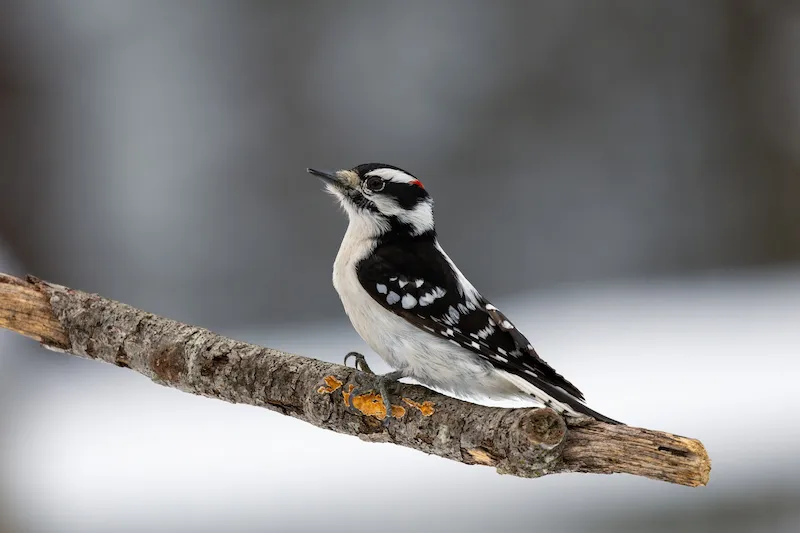
Woodpeckers are some of the most rewarding feeder birds: bold black-and-white patterns, a flash of red on the head, and a habit of hitching up the feeder pole as if it were a tree trunk. Most of them stay all year, so a woodpecker you win over in October will likely still be visiting in March.
By the My Window Birds editors · Published October 8, 2026 · Sources
The woodpeckers you can expect in the Northeast
| Bird | How to know it | At the feeder |
|---|---|---|
| Downy Woodpecker 5–7 in — the smallest |
Black and white with a short, stubby bill; males have a small red patch on the back of the head | Suet, black-oil sunflower, peanuts. The most frequent visitor by far |
| Hairy Woodpecker 7–10 in |
A larger Downy with a bill nearly as long as its head and all-white outer tail feathers | Suet above all; most common in wooded yards |
| Red-bellied Woodpecker about 9½ in |
Barred black-and-white back; red from bill to nape on males, nape only on females. The "red belly" is only a faint blush | Suet, peanuts, sunflower seed |
| Northern Flicker 11–12 in |
Brown with black spots and a black bib; flashes yellow under the wings in flight | Usually on the lawn eating ants; occasionally suet |
| Pileated Woodpecker 16–19 in — crow-sized |
Black, with a flaming red crest and white stripes on the face and neck | Mostly carpenter ants; in wooded neighborhoods, sometimes suet |
| Yellow-bellied Sapsucker 7–9 in |
Black and white with a red forehead; drills neat rows of small holes in tree bark | Rarely at feeders; seen mostly in spring and fall migration |
The first three are year-round residents and the backbone of any Northeast woodpecker show. Red-bellied Woodpeckers are relative newcomers to the northern part of the region: they've been expanding their range north for decades and only became common in Massachusetts in the last twenty years or so. Many flickers head south for the winter, though some stay.
Downy or Hairy? The two-second test
These two look almost identical — same checkered back, same white stripe down the back, same red patch on the males. Here's how to tell them apart:
- Look at the bill. This is the one that settles it. A Downy's bill is a short little thorn, much shorter than its head. A Hairy's bill is a chisel, nearly as long as its head.
- Check the outer tail feathers. A Downy has black spots or bars on its white outer tail feathers. A Hairy's are clean white.
- Size helps, but only side by side. A Downy is about sparrow-sized; a Hairy is closer to a robin. Alone on a feeder, size is surprisingly hard to judge.
- Consider the setting. Downies turn up everywhere, including small suburban yards and city parks. Hairies prefer bigger trees and more woods.
Step 1: Put out suet
Woodpeckers are insect eaters at heart, and suet — rendered beef fat — is the closest thing at a feeder to the beetle larvae they chisel out of bark. It's dense energy, which is exactly what they need in cold weather.
- Start with a plain suet cake in a wire cage — store-bought or homemade. No special flavors needed; cakes with nuts or seeds mixed in simply widen the guest list.
- Hang it near a tree trunk. Woodpeckers like to approach the way they would a tree — hitching up the bark — so a cage on or near a trunk gets found quickly.
- Use it fall through spring. Cold weather keeps suet firm and fresh. In summer, switch to "no-melt" cakes or take suet down when it softens or smells off.
- Starlings hogging it? Try an upside-down suet feeder, which only opens on the bottom. Woodpeckers feed hanging upside down without a second thought; starlings find it awkward.
- Squirrels hogging it? A baffle is the real fix — see our squirrel-proof feeding guide. Hot-pepper suet is sold for this too, but some wildlife experts advise against it because the pepper can irritate mammals' eyes.
Step 2: Add peanuts and sunflower
- Shelled peanuts in a mesh peanut feeder are a woodpecker favorite — they chip off small pieces through the wire. Buy plain, unsalted peanuts sold for birds.
- Black-oil sunflower in a hopper or tube feeder brings in Downy, Hairy, and Red-bellied Woodpeckers along with everyone else. Our bird food guide has the full chart.
- Sunflower hearts — the shelled kernels — are easy work for small Downies and leave no mess.
Step 3: Give them something to brace against
A woodpecker climbs using its stiff tail feathers as a prop, like the third leg of a stool. Small Downies manage fine on an ordinary suet cage, but bigger birds feel more secure with support:
- Tail-prop suet feeders have a long board below the cage. They're the best way to coax in Hairy, Red-bellied, and — if you're lucky — Pileated Woodpeckers.
- Log feeders — a short log with holes drilled in it and packed with suet — look natural and give a perfect grip.
Step 4: Leave some dead wood
Dead trees and dead limbs, called snags, are woodpecker gold. Woodpeckers feed on the insects inside them, carve their nest holes in them, and use them as drums to announce their territory. If a dead tree isn't a hazard to your house, a path, or a neighbor, consider leaving it standing — or have it cut down to a tall stump instead of removing it entirely.
Living trees help too. Oaks drop acorns that Red-bellied Woodpeckers store for winter, and native berry shrubs like dogwoods feed flickers in fall.
Step 5: Offer water
Woodpeckers drink and bathe like other birds, and a birdbath near your feeders makes the yard even more attractive. In winter, a heated birdbath is a real draw — more on that in what to feed birds in winter.
What to expect through the year
- Fall and winter: peak suet season. Downy and Hairy Woodpeckers often travel with the mixed winter flocks of chickadees, titmice, and nuthatches, so when one group shows up, the others often follow.
- Spring: drumming season. That rapid-fire hammering on a dead limb, a gutter, or a chimney cap isn't feeding — it's a woodpecker claiming its territory and calling for a mate.
- Summer: watch for parents bringing fledglings to the suet feeder and feeding them beak to beak. Keep no-melt suet out and you'll have a front-row seat.
Will woodpeckers damage my house?
Feeding woodpeckers doesn't teach them to drill on houses — that behavior has other causes. According to Mass Audubon, woodpeckers are most likely to work on dark brown or gray siding and on natural cedar or redwood, most drilling happens from September through November, and the culprit is often a young, inexperienced bird. Because it's seasonal, many cases stop on their own.
If the damage is real, deterrents that move or block work best: shiny Mylar streamers hung over the spot, a loose plastic sheet that flaps in the wind, or bird netting stretched at least six inches from the wall. Keep in mind that woodpeckers are protected under the federal Migratory Bird Treaty Act, so the goal is always to discourage, never to harm.
The bottom line
To attract woodpeckers: hang a suet cage near a tree trunk, add shelled peanuts and black-oil sunflower, choose a tail-prop feeder for the bigger species, leave dead wood where it's safe, and keep water out. Do that, and the Downy on your feeder pole may soon have company.
Get the free guide: Backyard Birds of the Northeast
Two of the 15 birds in our free printable guide are woodpeckers. Get a card for each one — plus every other common Northeast feeder bird and what to feed it.
Download the Free GuideCommon questions
What is the best food to attract woodpeckers?
Suet. A plain suet cake in a wire cage attracts more woodpeckers than any other food. Shelled, unsalted peanuts and black-oil sunflower seed come next.
How can I tell a Downy Woodpecker from a Hairy Woodpecker?
Look at the bill. A Downy's bill is much shorter than its head; a Hairy's is nearly as long as its head. Downies also have black spots on their white outer tail feathers, while a Hairy's are all white.
Do woodpeckers eat suet in summer?
Yes. Woodpeckers will use suet year-round, and parents often bring their young to suet feeders in early summer. In hot weather, use "no-melt" suet cakes and replace any suet that turns soft or rancid.
Will a Pileated Woodpecker come to a feeder?
Sometimes. Pileated Woodpeckers eat mostly carpenter ants, but in wooded neighborhoods they do visit suet — especially a tail-prop feeder or a log feeder that gives their big frame something to brace against.
Why is a woodpecker pecking on my house?
Usually to claim territory, to search for insects, or — most often in fall — because a young bird is exploring. Mass Audubon notes most drilling happens September through November and often stops on its own. Mylar streamers or netting set six inches off the wall can discourage it.
Sources
- Project FeederWatch (Cornell Lab) — Tricky Bird IDs: Downy Woodpecker and Hairy Woodpecker
- Audubon Magazine — How to Tell a Hairy Woodpecker From a Downy Woodpecker
- National Audubon Society — Guide to North American Birds: Red-bellied Woodpecker
- National Audubon Society — Guide to North American Birds: Pileated Woodpecker
- National Audubon Society — Guide to North American Birds: Northern Flicker
- Mass Audubon — Woodpeckers
- Connecticut DEEP — Woodpeckers fact sheet
Keep reading: meet the 15 birds of the Northeast, see what to feed birds in winter, find the best spot for your feeder, or learn how to attract chickadees — the woodpeckers' favorite winter companions.