Feeding birds · Month by month
The Northeast Bird Feeding Calendar
The short answer: winter is peak feeder season. From December through March, keep sunflower and suet full and the water open. Hang a hummingbird feeder in the last week of April, put out oranges for orioles in early May, and keep nectar and birdbaths fresh all summer. In fall, leave the seed heads standing and start suet as the nights turn cold. In bear country, feed birds only from about December 1 to April 1.
Every month brings different birds to a Northeast yard, and each one has a few jobs that matter. This calendar covers New England, New York, New Jersey, and Pennsylvania. Dates shift by a week or two between the southern coast and the northern mountains, and with the weather each year, so use them as a guide.
By the My Window Birds editors · Published November 25, 2026 · Sources
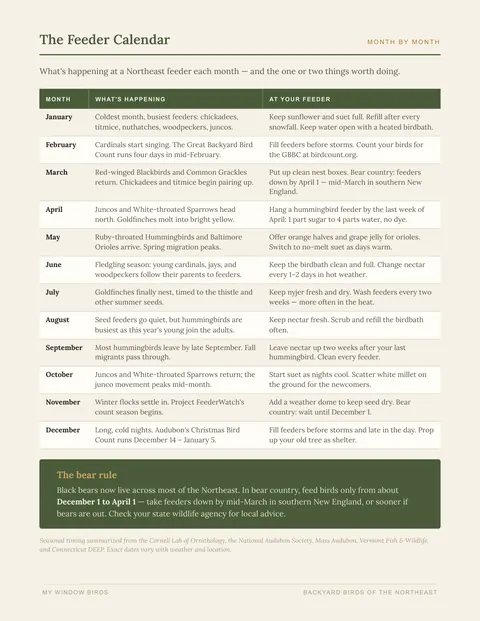
The year at a glance
| Month | At your feeder |
|---|---|
| January | Peak feeder season. Keep sunflower and suet full and the water open. |
| February | Great Backyard Bird Count. Fill feeders before storms. |
| March | Blackbirds return. Put up clean nest boxes; in bear country, take feeders down. |
| April | Juncos head north. Hang a hummingbird feeder late in the month. |
| May | Orioles and hummingbirds arrive. Put out oranges; switch to no-melt suet. |
| June | Fledglings visit feeders and baths. Keep nectar and water fresh. |
| July | Goldfinches nest. Keep nyjer dry; wash feeders every two weeks. |
| August | Male hummingbirds leave first. Keep nectar fresh for the young. |
| September | Fall migration peaks. Keep one nectar feeder up after the last hummingbird. |
| October | Juncos return. Start suet, scatter millet, leave the leaves. |
| November | FeederWatch begins. Keep seed dry; in bear country, wait. |
| December | Christmas Bird Count. Keep feeders full all afternoon. |
January
What's happening: For most of the East, the coldest days of the year come in January (NOAA). Feeders are at their busiest: last winter in Project FeederWatch's Northeast region, Dark-eyed Juncos visited 92% of feeders, Black-capped Chickadees 90%, Downy Woodpeckers 86%, White-breasted Nuthatches 77%, and Tufted Titmice 63%.
What to do:
- Keep black-oil sunflower and suet full. Mass Audubon calls black-oil sunflower the favorite of most feeder birds, and suet's calories are especially valuable in cold weather.
- Clear the snow. The National Wildlife Federation suggests stamping down snow under feeders and keeping a path to them clear after big storms.
- Keep water open with a heated birdbath or frequent refills. Never add glycerin (Mass Audubon). Here's how to keep a bird bath from freezing.
- Recycle your Christmas tree. After the holidays, Iowa State Extension suggests setting the tree out in the yard for birds, and the National Wildlife Federation suggests using it as the base of a brush pile for shelter.
Feeders matter most in a hard freeze. In a Wisconsin study described by the National Wildlife Federation, chickadees with access to feeders nearly doubled their survival rate in harsh weather below 10°F.
February
What's happening: Days lengthen and birds start to sing. The Great Backyard Bird Count runs February 12–15, 2027: count birds for as little as 15 minutes on one or more days and report them at birdcount.org (Audubon). The first flocks of Red-winged Blackbirds often show up in the last week of February, according to Mass Audubon's breeding bird atlas. Titmouse pairs start to leave their winter flocks as early as February.
What to do:
- Fill feeders before storms. The National Wildlife Federation recommends several feeders during snow and ice storms, when birds need the most food.
- Count your birds for the GBBC. It's free, and backyard counts count.
March
What's happening: Red-winged Blackbirds and Common Grackles pour back in from late February through March. Mass Audubon's atlas notes that cardinals sing year-round, but much more often from March on, and chickadees start courting in late March and April.
What to do:
- Get nest boxes ready. Audubon suggests cleaning boxes in fall and again in early spring. NestWatch adds that if mice moved in over the winter, you should definitely clean the box in spring.
- Bear country: take feeders down. Connecticut DEEP says to take feeders down by mid-March, and New Hampshire says by March 15 south of the White Mountains. Elsewhere, most agencies say by April 1, or sooner if bears are out. See our state-by-state guide to bird feeders and bears.
April
What's happening: Winter birds head north. In Massachusetts, the northward junco movement usually peaks in mid-April, and White-throated Sparrow migration peaks between mid-April and mid-May (Mass Audubon atlas). Male goldfinches molt into bright yellow between March and May. The first Ruby-throated Hummingbirds arrive in the second half of the month: in 2026, Journey North observers reported one in Connecticut on April 15 and on Long Island on April 22, where the normal date is April 24–28.
What to do:
- Hang a hummingbird feeder in the last week of April or the first week of May, Mass Audubon advises. Audubon suggests putting it out about a week before hummingbirds normally arrive in your yard.
- Mix nectar at 1 part white sugar to 4 parts water. No red dye is needed.
- Bear country: Connecticut DEEP asks residents to skip hummingbird feeders too. Plant cardinal flower and bee balm instead.
May
What's happening: May is the peak of spring migration. Audubon calls May the peak season at Mount Auburn Cemetery in Cambridge, one of the most popular birding spots in Massachusetts. Baltimore Orioles normally arrive in the first week of May, and most hummingbirds arrive in May.
What to do:
- Put out oranges for orioles. Cut them in half and push them onto a branch or a fruit feeder. Nebraska Extension suggests changing the halves every day or two and cleaning jelly feeders every 2 to 3 days. FeederWatch notes that orioles also drink from nectar feeders, mixed at 1 part sugar to 6 parts water.
- Switch to no-melt suet as days warm, and hang it in the shade (National Wildlife Federation). Stop homemade suet once it's warmer than about 50–55°F (Audubon); see our homemade suet recipe.
June
What's happening: Fledgling season. Audubon notes that most songbirds leave the nest from late June through July. Parent chickadees and Downy Woodpeckers bring their young to feeders and birdbaths, and in Massachusetts cardinal fledglings turn up from May into September.
What to do:
- Keep the birdbath clean and fresh. FeederWatch suggests changing the water every couple of days. Mass Audubon notes that parent birds bring their young to water for their first baths.
- Change nectar often. In hot weather, Audubon says to empty and clean the feeder every day or every other day. Around 90°F and above, change it daily.
July
What's happening: American Goldfinches finally nest, in the "dog days of July and August," Audubon says, timed to the peak of thistle seed. Many Baltimore Orioles start south as early as July.
What to do:
- Keep nyjer dry. Store seed in a cool, dry place and throw out any that gets damp or moldy (Mass Audubon). More goldfinch tips: how to attract goldfinches.
- Wash feeders about every two weeks, more often in hot, humid weather (Audubon, Mass Audubon). Here's how to clean a bird feeder.
- Take a break from suet. Mass Audubon notes it can turn rancid in summer heat.
August
What's happening: Hummingbird migration begins. Adult males leave first, followed by females and young (Journey North). Some late hummingbird nests in Massachusetts still hold young in late August. Goldfinch parents are still feeding fledglings into September.
What to do:
- Keep nectar fresh: every day or two in the heat. The young hummingbirds need it before their first migration.
- Scrub and refill the birdbath often in dry spells.
September
What's happening: Fall migration peaks in September (Audubon). Most hummingbirds leave Massachusetts between late August and late September. It's also a bad time for window strikes: the American Bird Conservancy notes that fall migration brings more building collisions than spring.
What to do:
- Keep one hummingbird feeder up for a week or two after you see your last hummingbird (Journey North), and take it down before freezing nights become common (Mass Audubon).
- Make windows safer. Dim or turn off outdoor lights at night during migration (FeederWatch), and mark glass near your feeders; see where to hang a bird feeder.
- Clean every feeder before the winter crowd arrives.
October
What's happening: The winter birds come back. In Massachusetts, the junco movement usually peaks in mid-October and ends about Thanksgiving, and White-throated Sparrows pass through from mid-September to early November (Mass Audubon atlas). Meet them in our guide to Dark-eyed Juncos.
What to do:
- Start suet once nights are reliably below about 50°F.
- Scatter a handful of white proso millet on the ground for juncos and sparrows (FeederWatch).
- Leave the leaves and seed heads. Audubon's advice is to go easy on fall yard work: fallen leaves hold the caterpillars and other insects birds eat, and birds eat coneflower and black-eyed Susan seeds all winter.
- Clean out nest boxes once the nesting season is over (Audubon, NestWatch).
November
What's happening: Winter flocks settle in. Common Grackles peak in early November, and wintering flocks of White-throated Sparrows settle after mid-month. Project FeederWatch runs from November 1 to April 30; U.S. participants pay $18 a year and count their feeder birds on two days in a row, as often as once a week.
What to do:
- Keep seed dry. A roof over the feeder, or a weather dome over a tube feeder, helps keep seed dry (FeederWatch).
- Bear country: wait. Vermont and New Hampshire say to put feeders up on December 1 or later, and Connecticut says December.
December
What's happening: The longest nights of the year. The National Wildlife Federation notes that chickadees start a winter morning with almost no body fat and gain 10% or more of their body weight during the day, fuel for the long night ahead. Cardinals are among the last birds to go to roost at dusk. Audubon's Christmas Bird Count runs December 14, 2026 to January 5, 2027.
What to do:
- Keep feeders full through the afternoon, so birds can fuel up for the long night.
- Join a count. Learn how in our guide to the Christmas Bird Count.
- Get ready for winter feeding: see what to feed birds in winter.
The bottom line
A Northeast feeder runs on the seasons: sunflower, suet, and open water in winter; nest boxes in March; hummingbird and oriole feeders from late April; fresh water and clean feeders all summer; seed heads, suet, and millet in fall. If you live in bear country, keep the feeders to the winter months. And every few weeks, look up from the calendar: the birds keep their own schedule, and it shifts a little every year.
Get the free guide: Backyard Birds of the Northeast
This calendar is also a one-page printable in our free 8-page guide, along with a seed chart and cards for the 15 most common Northeast feeder birds. Print it and keep it by the window.
Download the Free GuideCommon questions
When should I put out bird feeders in the Northeast?
Outside bear country, you can feed birds year-round; October, when juncos and sparrows return, is a natural time to start. In bear country, wait until bears are denned: most Northeast wildlife agencies say December 1, and take feeders down by April 1 (by mid-March in southern New England).
When should I put out my hummingbird feeder in the Northeast?
In the last week of April or the first week of May, Mass Audubon advises. The first hummingbirds can reach southern New England by mid-April, so if you live near the coast or in Connecticut, earlier is fine. Mix 1 part white sugar to 4 parts water, with no dye.
When should I take down my hummingbird feeder?
Keep at least one feeder up for a week or two after you see your last hummingbird, usually in late September, and take it down before freezing nights become common. Don't worry about delaying them: as Journey North puts it, "the feeders do not entice them to stay."
When should I start putting out suet?
In October, once nights are reliably cool. Audubon advises offering homemade suet only below about 50–55°F; in warm weather, suet can melt or turn rancid. If you want to offer it in spring or summer, use no-melt (all-weather) suet in the shade.
When should I clean out birdhouses?
After the nesting season, in fall, once the young have left. Audubon suggests a second cleaning in early spring, and NestWatch says to clean in spring if mice used the box over winter. Don't remove an active nest during the season.
Sources
- NOAA National Centers for Environmental Information — When to expect the coldest day of the year
- Project FeederWatch — Top 25 Feeder Birds (Northeast region, 2025–26 season)
- Project FeederWatch — How to Participate
- Project FeederWatch — Feeding Birds
- Mass Audubon — Bird Feeding
- Mass Audubon — Ruby-throated Hummingbirds
- Mass Audubon — Breeding Bird Atlas 1: Dark-eyed Junco
- Mass Audubon — Breeding Bird Atlas 1: Red-winged Blackbird
- Mass Audubon — Breeding Bird Atlas 1: Northern Cardinal
- Mass Audubon — Breeding Bird Atlas 1: Ruby-throated Hummingbird
- National Audubon Society — Great Backyard Bird Count
- Audubon — Christmas Bird Count: Join
- National Audubon Society — Hummingbird Feeding FAQs
- National Audubon Society — Birding Massachusetts
- National Audubon Society — 10 Fun Facts About the American Goldfinch
- National Audubon Society — Guide to North American Birds: Baltimore Oriole
- National Audubon Society — Help Birds This Winter: Go Easy on Fall Yard Work
- National Audubon Society — Winterize Your Yard for Birds
- National Audubon Society — How to Feed Birds Safely in Winter
- National Audubon Society — This Addictive Homemade Suet Will Keep Your Birds Returning for More
- National Wildlife Federation — Backyard Birding (2008)
- National Wildlife Federation — The Case for Summer Bird Feeding
- National Wildlife Federation blog — Ten Simple Tips for Successful Winter Bird Feeding
- National Wildlife Federation blog — Recycle Your Tree for Wildlife
- National Wildlife Federation — Hummingbirds (2020)
- NestWatch — To Clean or Not to Clean Your Nest Box
- Journey North — Hummingbird and oriole arrivals, spring 2026
- Journey North — Fueling a long journey (hummingbird fall migration)
- Journey North — Hummingbird feeders in fall
- American Bird Conservancy — Global Bird Rescue Week 2026
- Nebraska Extension (Lancaster County) — Attracting Baltimore Orioles to Your Landscape
- Iowa State University Extension — Ways to dispose of a Christmas tree after the holidays
- Vermont Fish & Wildlife — December Is the Start of Bird Feeding Season
- Connecticut DEEP — Bears increase activity in the spring (April 2026)
Keep reading: in bear country, check the dates for your state in bird feeders and bears, see what to stock in the best bird food guide, or meet the 15 birds of the Northeast.